Choosing the right TMT bars is one of the most important decisions in any construction project. Whether you are building a residential house, commercial complex or large infrastructure project, the quality of steel reinforcement directly affects the strength, durability and safety of the structure.
Among the different grades available in the Indian market, Fe 550 and Fe 550D Steel bars are commonly considered for construction. Both grades offer a minimum yield strength of 550 MPa, but they differ in their ductility and elongation properties.
Understanding these differences helps builders, engineers and contractors select the right reinforcement steel based on structural requirements. In this guide, we will explore the major differences between Fe 550 and Fe 550D TMT bars and explain why choosing the right grade matters for long-lasting construction.
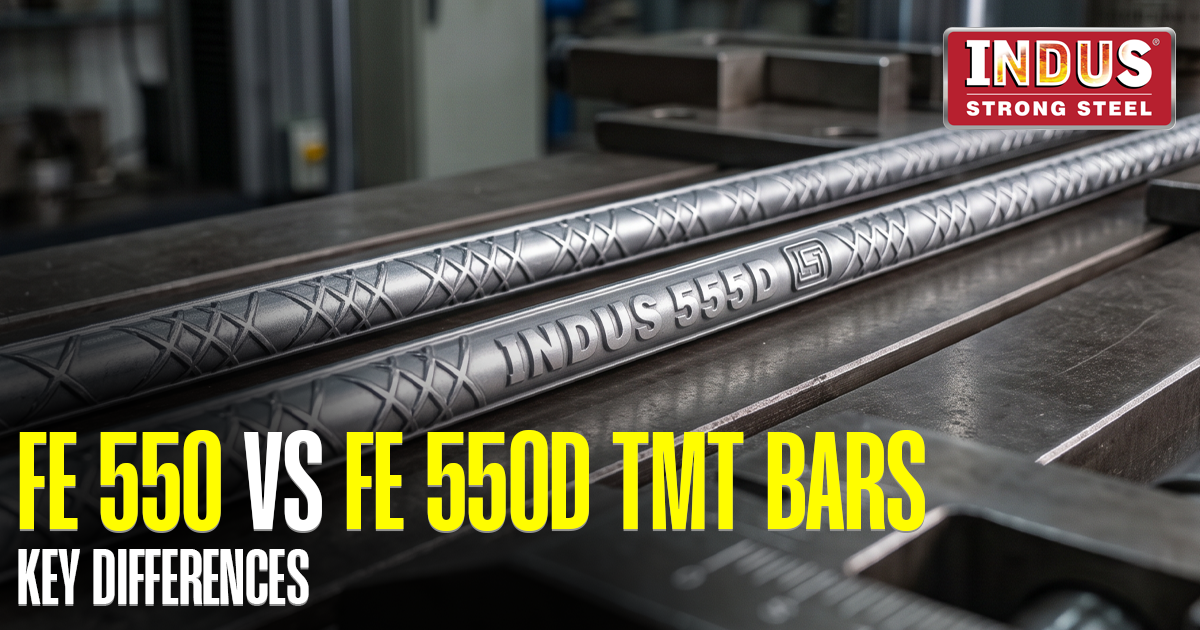
Fe 550 vs Fe 550D TMT Bars: Key Differences
Although both grades have the same minimum yield strength, their ability to withstand deformation differs. The major difference is ductility.
- Minimum Yield Strength:
- Fe 550: 550 MPa
- Fe 550D: 550 MPa
- Minimum Tensile Strength:
- Fe 550: 585 MPa
- Fe 550D: 600 MPa
- Minimum Elongation:
- Fe 550: 10%
- Fe 550D: 14.5%
- Tensile-to-Yield Ratio:
- Fe 550: 1.06
- Fe 550D: 1.08
- Ductility:
- Fe 550: Standard ductility
- Fe 550D: Higher ductility
- Deformation Capacity:
- Fe 550: Lower deformation capacity
- Fe 550D: Higher deformation capacity
Note: These are the minimum specified mechanical properties under the relevant IS 1786 requirements. Actual test results may vary depending on the manufacturer and production batch.
A. Strength and Load-Bearing Capacity
Strength is an important factor when selecting reinforcement steel for construction. Both Fe 550 and Fe 550D TMT bars have a minimum yield strength of 550 MPa.
However, Fe 550D has a higher minimum tensile strength of 600 MPa compared to 585 MPa for Fe 550.
This means Fe 550D offers a higher minimum tensile-strength requirement, along with improved ductility. These properties make it a suitable option for structural designs that require both strength and deformation capacity.
B. Ductility and Flexibility
Ductility refers to the ability of steel to stretch or deform before breaking. It is an important property because structures may experience different types of stress during their lifetime.
Fe 550D TMT bars have a minimum elongation requirement of 14.5%, while Fe 550 bars have a minimum requirement of 10%.
This higher elongation requirement allows Fe 550D bars to undergo more deformation before failure. It is particularly useful in structures where flexibility and energy absorption are important.
C. Earthquake Resistance
Earthquakes create sudden movements and additional stress on buildings. Reinforcement steel with good ductility helps structural members undergo controlled deformation and absorb seismic energy.
Fe 550D TMT bars are designed with higher ductility requirements, making them suitable for structural applications that require ductile reinforcement.
However, earthquake-resistant construction depends on more than steel grade alone. Proper structural design, reinforcement detailing, concrete quality and construction practices are equally important.
D. Chemical Composition
The chemical composition of reinforcement steel plays an important role in its mechanical performance, weldability and ductility.
Fe 550D has stricter chemical composition requirements than standard Fe 550, particularly for carbon, sulphur and phosphorus.
These controlled limits help improve the steel's ductility and reduce the risk of brittle behaviour.
For this reason, checking the manufacturer's test certificate and BIS compliance is important before purchasing TMT bars.
E. Bending and Re-bending Performance
TMT bars need to be bent into different shapes during construction to create reinforcement arrangements for columns, beams, slabs and foundations.
Ductility is important during these operations because steel must withstand bending without developing cracks.
Fe 550D's higher ductility requirements provide better deformation capacity. However, bars should always be bent and handled according to the applicable standards and structural engineer's instructions.
Which TMT Bar Is Better for House Construction?
Selecting between Fe 550 and Fe 550D depends on the structural design, building requirements and recommendations of the structural engineer.
For residential construction, Fe 550D is often considered a suitable choice because it combines high yield strength with higher ductility.
Here are some common construction applications:
- Foundation: Requires strength and durability.
- Columns: Require load-bearing strength and ductility.
- Beams: Require strength and deformation capacity.
- Slabs: Require reinforcement strength and proper concrete bonding.
- Multi-storey Buildings: Require strength and structural stability.
- Earthquake-Resistant Structures: Require higher ductility and proper seismic detailing.
The right grade and bar diameter should always be selected based on structural calculations rather than choosing steel only because it has a higher grade.
Why Choose Indus TMT for Your Construction Requirements?
When purchasing reinforcement steel, selecting a manufacturer that focuses on quality, manufacturing consistency and product performance is essential.
Indus TMT focuses on producing high-strength reinforcement steel using controlled manufacturing processes and quality checks.
Here are some reasons to consider Indus TMT:
1. Advanced Manufacturing Process
Indus TMT follows a manufacturing process involving quality raw materials, billet production and thermo-mechanical treatment to achieve consistent steel properties.
2. Higher Ductility
Indus highlights improved elongation and ductility in its 555-D TMT product, helping meet demanding reinforcement requirements.
3. X-Ribbed Technology
The X-ribbed surface design provides increased contact area between steel and concrete, supporting better bonding.
4. Quality Control
Consistent manufacturing and quality checks help maintain the mechanical and chemical properties of reinforcement steel.
5. Reliable Construction Solutions
Indus TMT offers reinforcement steel solutions for individual homeowners, builders, contractors and infrastructure projects.
Indus 555-D TMT specifications and product information are available on its official website.
Explore: Indus TMT Products.
Conclusion: Fe 550 or Fe 550D – Which Should You Choose?
Both Fe 550 and Fe 550D Steel bars provide high reinforcement strength, but their ductility requirements make them different.
Fe 550 offers a minimum yield strength of 550 MPa with 10% minimum elongation, whereas Fe 550D offers the same minimum yield strength with 14.5% minimum elongation and higher minimum tensile strength.
For construction projects where greater ductility and deformation capacity are important, Fe 550D is a strong option to consider.
However, the final selection should always follow the structural design and recommendations of a qualified engineer.
If you are looking for dependable reinforcement steel for your next project, explore the products offered by Indus TMT and choose the right steel solution for your construction requirements.
Visit Indus TMT to learn more about its TMT steel products.
Frequently Asked Questions (FAQs)
1. What is the main difference between Fe 550 and Fe 550D TMT bars?
The main difference is ductility. Both have a minimum yield strength of 550 MPa, but Fe 550D has a higher minimum elongation requirement of 14.5%, compared to 10% for Fe 550.
2. Is 550D tmt steel good for house construction?
Yes. 550D tmt steel is suitable for residential construction when specified by a qualified structural engineer. Its combination of high strength and ductility makes it a useful reinforcement option.
3. Why is the D added to Fe 550D steel?
The letter D stands for ductility. It indicates that the steel meets additional ductility-related requirements, including higher minimum elongation and controlled chemical composition.
4. Is Fe 550D better than Fe 550?
Fe 550D offers higher minimum tensile strength and elongation requirements than Fe 550. It can be advantageous when improved ductility is required. However, the appropriate grade depends on the structural design.
5. Can Fe 550D TMT bars be used for columns and beams?
Yes. Fe 550D TMT bars can be used in columns and beams when the grade and diameter are specified in the structural drawings.
6. What should I check before purchasing 550D steel?
Check BIS certification, grade marking, yield strength, tensile strength, elongation, bar dimensions and the manufacturer's test certificate.