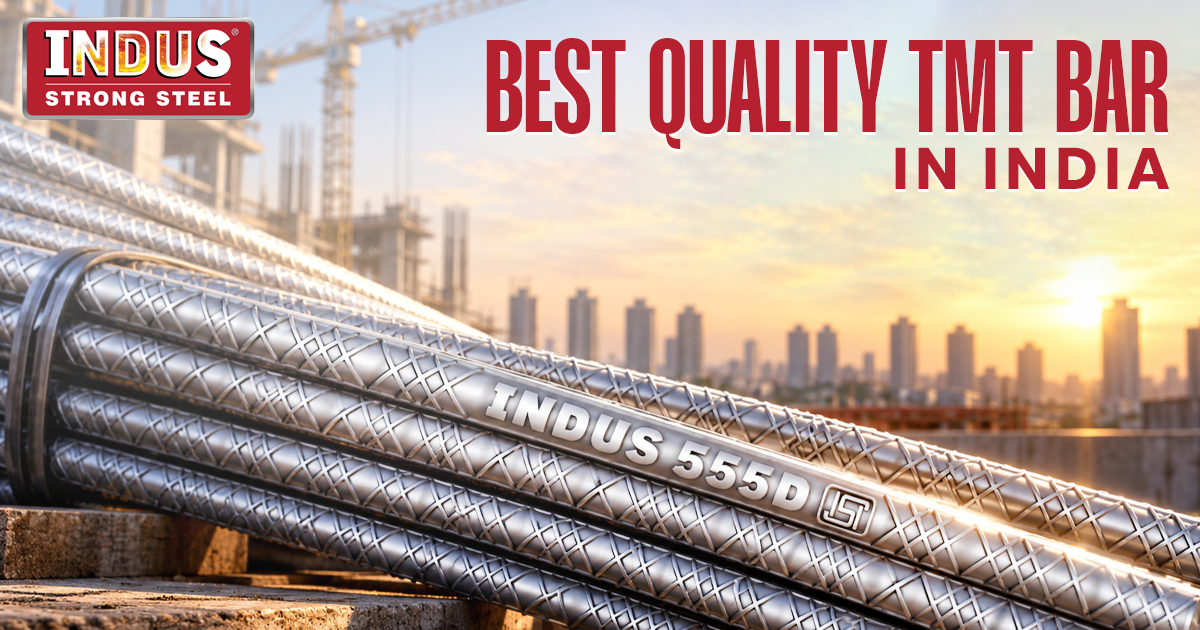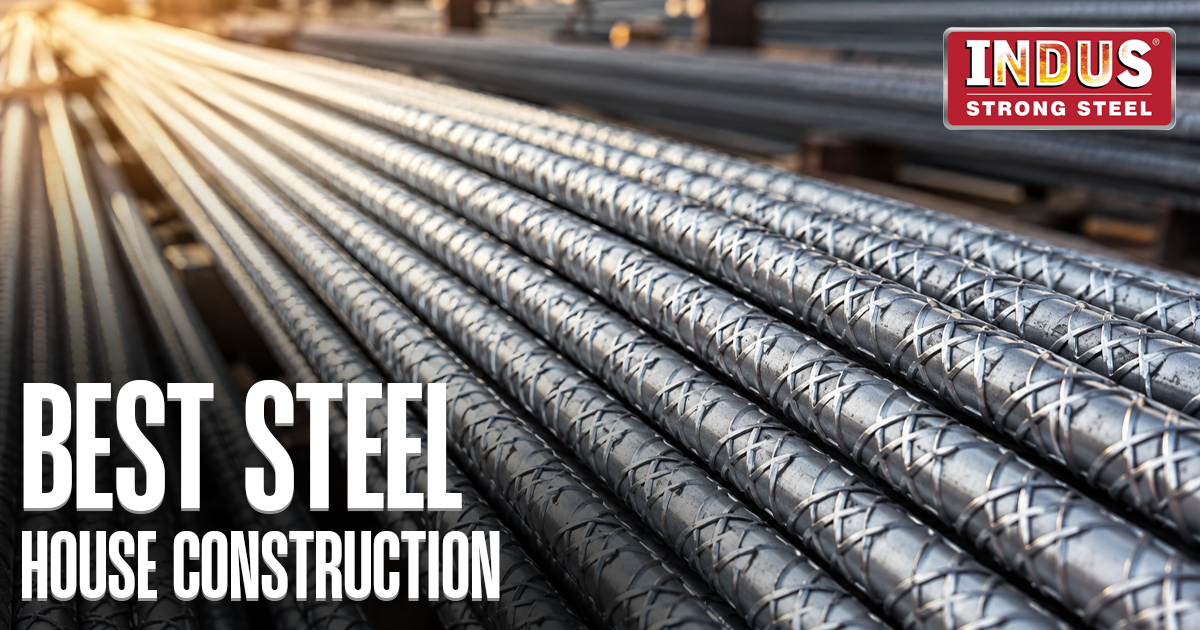

Which type of steel is best for house construction?
For most reinforced concrete houses, TMT (Thermo-Mechanically Treated) bars are the standard choice, usually in a ductile grade such as Fe 550D, as specified by your structural engineer. The right grade and bar size always come from your structural drawings, not from a general rule or a seller's suggestion.
This guide covers the types of steel bars, TMT grades, the difference between Fe 550 and Fe 550D, what to check before buying TMT bars, and how to choose bar sizes. For a quick read, jump to the FAQ section at the end.
Quick answer: Ask your engineer to specify a BIS-certified ductile TMT grade (such as Fe 500D or Fe 550D) for foundations, columns, beams and slabs. Verify the grade, certification and test certificates before every purchase.
Tip 1: Know the Types of Steel Bars Used in House Construction
Concrete is strong in compression but weak in tension. Reinforcement steel carries the tensile forces that concrete cannot, which is why steel bars are placed in foundations, columns, beams and slabs.
 For most reinforced concrete houses, TMT bars are the main option to discuss with your structural engineer. Browse the INDUS TMT steel products page to see the grades and specifications available.
Tip 2: Understand the Different Grades of TMT Steel Bars
A TMT grade tells you the minimum yield strength the bar must achieve under the standard. In India, IS 1786 covers high-strength deformed steel bars and wires for concrete reinforcement. Grades are written as "Fe" followed by the minimum yield strength in MPa. A "D" suffix means the grade has enhanced ductility requirements.
 A grade number alone does not make one brand better than another. Always check the grade declared on the product and its supporting test certificate. For the official standard, see the Bureau of Indian Standards (BIS) listing for IS 1786. To see how a manufacturer's declared values compare with these minimums, review the INDUS TMT steel products page.
Tip 3: Learn the Difference between Fe 550 and Fe 550D Steel
Fe 550 and Fe 550D have the same minimum yield strength of 550 MPa. The difference is ductility. Under IS 1786, Fe 550 requires a minimum elongation of 10%, while Fe 550D requires 14.5%. This means Fe 550D can stretch and deform more before fracturing under the specified test conditions.
Why does the "D" matter?
- It stands for "ductile." It does not mean the steel cannot break.
- Ductile bars give warning. Under heavy or unexpected loads, ductile reinforcement can deform visibly rather than failing suddenly and brittlely.
- It is not a guarantee of earthquake safety. Seismic performance also depends on structural design, reinforcement detailing, concrete quality and workmanship, in line with codes such as IS 456, IS 1893 and IS 13920.
When comparing Fe 550 and Fe 550D, check the declared grade, the applicable standard, the test documentation and whether the grade matches your structural design.
Tip 4: Choose 550D Steel Only When the Design Calls for It
Fe 550D can be a good option when your structural design specifies a 550 MPa grade with enhanced ductility. A higher grade is not automatically the best choice for every house, so confirm the required grade with your engineer before purchasing.
The real question for homeowners is not "is this steel strong?" but "does this steel's specified strength and ductility match my building's design?" The quality of the finished structure also depends on:
- Correct reinforcement placement and bar spacing
- Adequate concrete cover
- Concrete quality and proper curing
- Skilled workmanship
Even excellent steel cannot make up for poor construction practices.
INDUS Fe 550D (INDUS 555-D): Declared Properties
INDUS markets its Fe 550D grade as INDUS 555-D TMT steel. The table compares the IS 1786 (ISI) minimums with the values INDUS declares for its Fe 550D bars.
*For ISI Fe 550, tensile strength is 585 N/mm² or 6% more than the yield strength, whichever is higher. ISI columns show IS 1786 minimum requirements; the INDUS column shows values declared by INDUS.
Here is what the INDUS values mean in practice:
- More ductility: INDUS declares a minimum elongation of 17%, which is 2.5 percentage points above the 14.5% required for ISI Fe 550D
- Extra strength margin: The declared yield strength of 560 N/mm² and tensile strength of 650 N/mm² sit above the 550 and 600 N/mm² minimums.
- Higher UTS/YS ratio: A ratio of 1.16 (against 1.08) means the bar keeps carrying load beyond its yield point, which supports ductile behavior.
- Lower carbon: A maximum of 0.22% carbon is listed by INDUS as helping weldability.
- Lower phosphorus and Sulphur: Maximums of 0.040% each, against 0.045%, are listed by INDUS as helping ductility.
- Manganese: INDUS declares a minimum of 0.62%, which it lists as giving better flexibility with strength.
These are manufacturer-declared values. Confirm them on the batch test certificate and with your structural engineer. To explore the range, visit the INDUS TMT steel products page or check the available TMT bar sizes.
Tip 5: Follow a Checklist Before Buying TMT Steel Bars
Do not choose steel on price, brand claims, appearance or an informal bending demonstration alone. Use this checklist:
- Grade and diameter: Confirm both match the structural drawings.
- BIS certification: Check the ISI mark and verify the manufacturer's licence through official BIS resources.
- Test certificates: Ask for traceable test documents showing mechanical properties (yield strength, tensile strength, elongation) and chemical composition.
- Surface and ribs: Look for visible defects, heavy rust, and irregular or damaged ribs.
- Weight and dimensions: Check nominal dimensions and mass against the standard. As a rule of thumb, a bar's mass per metre is roughly d² ÷ 162 kg (d in mm).
- Chemical composition: Review documented sulphur and phosphorus levels against the grade's limits.
- Storage and handling: Keep bars off the ground and protected from contamination and damaging corrosion.
Low sulphur and phosphorus can be relevant to steel quality, but they must be judged against the applicable specification and the full test report. No single property proves overall quality.
The BIS product manual for IS 1786 lists checks such as surface characteristics, nominal mass, tensile properties, elongation, and bend and rebend tests. Compare the test certificate for each batch with the published specification of the product you choose, such as the INDUS TMT steel products specifications.
Tip 6: Pick the Right TMT Bar Size from the Structural Drawings
There is no single TMT bar diameter that is best for every part of a house. Diameters are selected using structural calculations, loads, spans, detailing and design codes.
- Common sizes you will encounter include 8 mm, 10 mm, 12 mm and 16 mm, but the sizes used vary by element and design.
- Different elements need different reinforcement: slabs, beams, columns and foundations are all detailed differently.
- Never substitute a different diameter or grade without your engineer's written approval.
Before ordering, confirm the grade, diameter, quantity and cutting lengths with your engineer or contractor. This reduces wastage and avoids unsuitable substitutions on site. You can view the available TMT bar sizes to match them against your structural drawings.
Tip 7: Involve a Structural Engineer in Every Steel Decision
You can compare brands and check documentation yourself, but the final choice of grade and diameter belongs in approved structural drawings. A qualified structural engineer will:
Select the grade and sizes based on your building's design and loads
Specify detailing for earthquake resistance where required
Approve any change in grade or diameter on site
Treat price and brand as secondary factors. Verified grade, certification and test reports come first.
Frequently Asked Questions about Steel for House Construction
Which type of steel is best for house construction?
Fe 550D TMT bars are an excellent choice for house construction, offering a combination of high tensile strength, ductility and flexibility. Choosing quality Fe 550D steel helps ensure better reinforcement for your home's long-term strength. Shop Now
Is Fe 550D better than Fe 550?
Both have minimum yield strength of 550 MPa. Fe 550D has higher ductility: its minimum elongation is 14.5% against 10% for Fe 550.
What does the "D" in Fe 550D mean?
The "D" in Fe 550D stands for Ductility. It means the steel can bend and stretch more under stress without breaking, making it more flexible and reliable for construction.
How do I check if TMT bars are genuine?
Check the ISI/BIS marking, verify the manufacturer's licence through BIS, ask for batch test certificates, and inspect ribs, surface and weight. Then compare the certificate values with the product's published specification, for example on the INDUS TMT steel products page.