Selecting steel for a building project involves more than comparing prices or strength labels. The chemical composition of steel influences how it behaves during manufacturing, fabrication and use. Understanding these properties can help buyers avoid confusing general material descriptions with specific structural grades.
Low carbon steel is widely used in fabrication, engineering, manufacturing and construction. Its relatively small carbon content supports forming and welding compared with higher-carbon plain steels. However, the right material depends on the intended application and the required performance.
For homeowners, contractors and civil engineers, this distinction is especially important when purchasing reinforcement. A bar described as mild steel does not automatically satisfy the requirements of a high-strength reinforcement grade.
In this guide, you will discover carbon percentages, material properties, manufacturing methods and practical purchasing checks — without confusing general steel classifications with reinforcement specifications. At INDUS TMT INDUSTRIES LIMITED, nearly three decades of steel manufacturing experience inform our focus on composition, processing and material quality.
1. What is low carbon steel?
Low carbon steel is generally a non-alloy steel containing up to about 0.30% carbon under Indian industry terminology. Often called mild steel, it supports bending, forming and fabrication. Its actual strength and suitability depend on the product specification, processing method and required mechanical performance.
Source: Ministry of Steel: industry glossary
2. What is the low carbon steel percentage and composition?
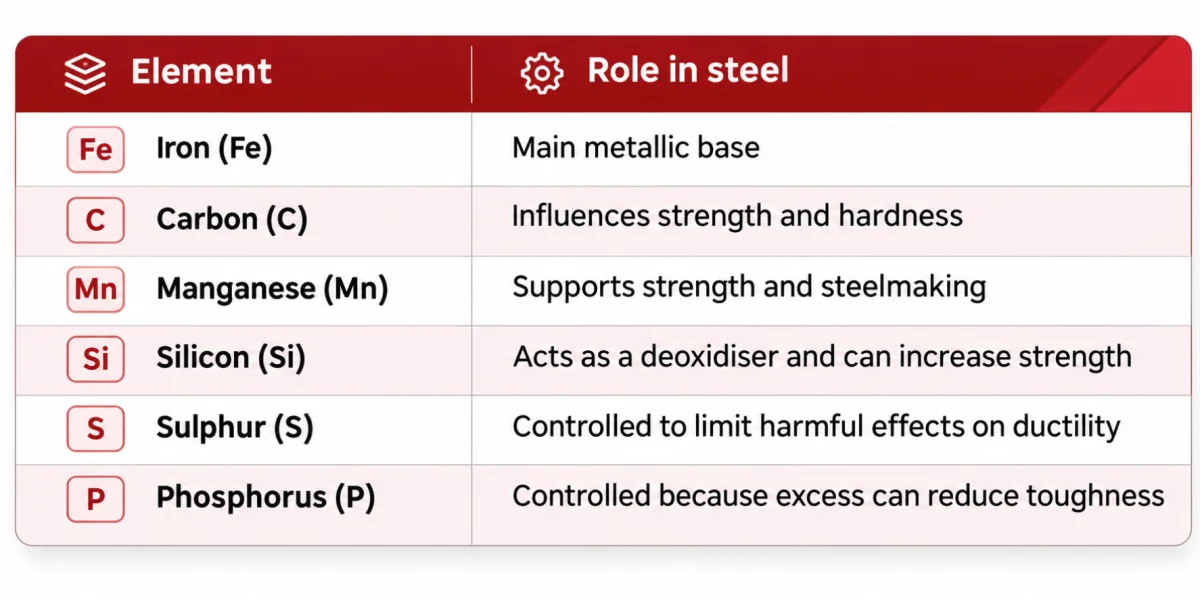
The carbon content is generally up to 0.30% by mass. Some product specifications use narrower limits. The low carbon steel carbon percentage is only one part of its chemistry. Iron forms the base, while other elements affect strength, processing behavior, weldability and ductility.
Carbon content in Indian reinforcement grades :
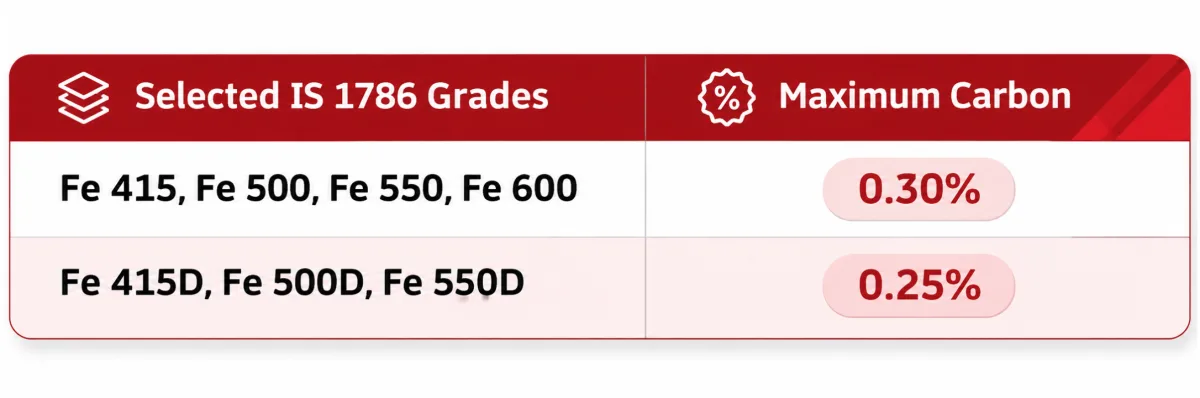
These are limits in IS 1786:2008 Amendment No. 1, not measured values for every batch. The D designation indicates enhanced specified elongation. Check the applicable standard and amendments when purchasing.
Source: BIS: IS 1786 Amendment No. 1
3. What are the common low carbon steel types and grades?
Steel products differ by specification, shape and processing route. Common examples include mild structural steel, low-carbon sheet, wire and deep-drawing products. Hot rolling and cold rolling describe how steel is processed. Neither method, by itself, confirms carbon content or suitability for a structural application.
Low carbon mild steel is used in general fabrication, such as gates, frames and tubes. Deep-drawing grades suit products that require substantial forming. Hot-rolled products include sections and plates, while cold-rolled sheets often offer closer dimensional tolerances and a smoother finish.
4. What are the physical and mechanical properties?
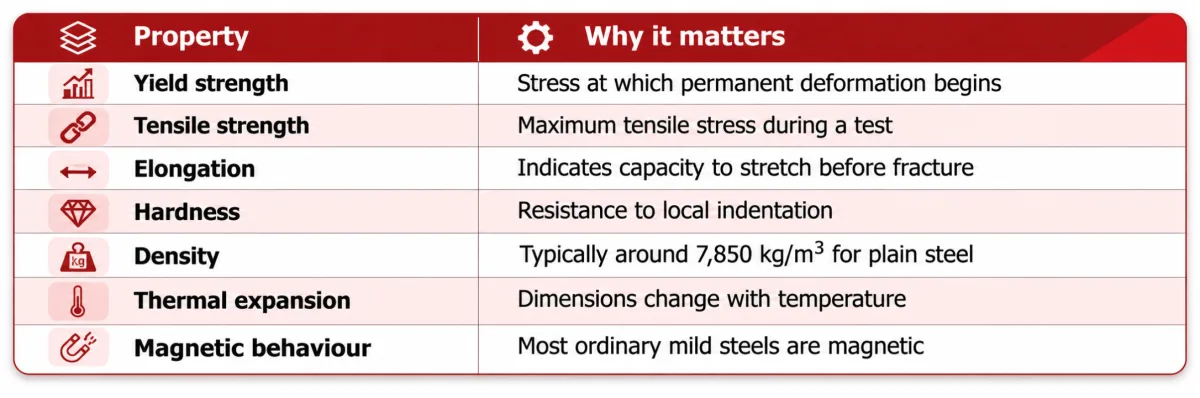
Lower carbon content generally supports ductility and formability, but does not define a fixed strength or hardness. Mechanical properties depend on chemistry, rolling, cooling and other treatments. Engineers should use tested grade-specific values instead of assuming that all mild steel products have identical performance.
Advantages and limitations
Advantages include easy forming, generally favourable weldability, broad availability and recyclability. These features make the material practical for many manufacturing and fabrication tasks.
Limitations include susceptibility to corrosion without suitable protection and lower attainable hardness than higher-carbon steels. Applications involving heavy wear may require a different grade or treatment. Strength must always be assessed against the design requirement.
5. How is low carbon steel manufactured?
Manufacturing involves producing or melting iron-bearing material, refining the chemistry, casting and rolling. Steelmakers control carbon during refining to achieve the required composition. The final processing route then establishes the product shape and helps achieve the mechanical properties specified for its intended use.
Raw material preparation: iron ore, direct-reduced iron or scrap is selected according to the production route.
Steelmaking and refining: carbon and other constituents are adjusted to the specified chemistry.
Casting: liquid steel solidifies into billets, blooms or slabs.
Rolling and finishing: the semi-finished material is shaped into bars, sections or sheets.
Testing: chemical and mechanical results are checked against product requirements.
TMT reinforcement receives controlled thermo-mechanical treatment to achieve its specified strength and ductility. This is a general industry process, not a description of a particular INDUS production line.
6. Where is this steel used in construction and industry?
The combination of formability and fabrication characteristics makes low-carbon grades useful across construction, automotive production and general engineering. Structural use requires the correct grade and design approval. The same broad material category may include products intended for very different loads, environments and manufacturing operations.
Construction: roofing sheets, steel frames, gates, binding wires and specified reinforcement products. Automotive: panels, brackets and formed parts. Manufacturing: tubes, machinery housings and containers. Residential improvement: railings, furniture and fabricated fixtures.
For beams, slabs, columns and foundations, select reinforcement according to the structural drawings. Mild steel descriptions alone cannot establish compliance with reinforcement requirements.
7. How does low carbon steel compare with high carbon steel?
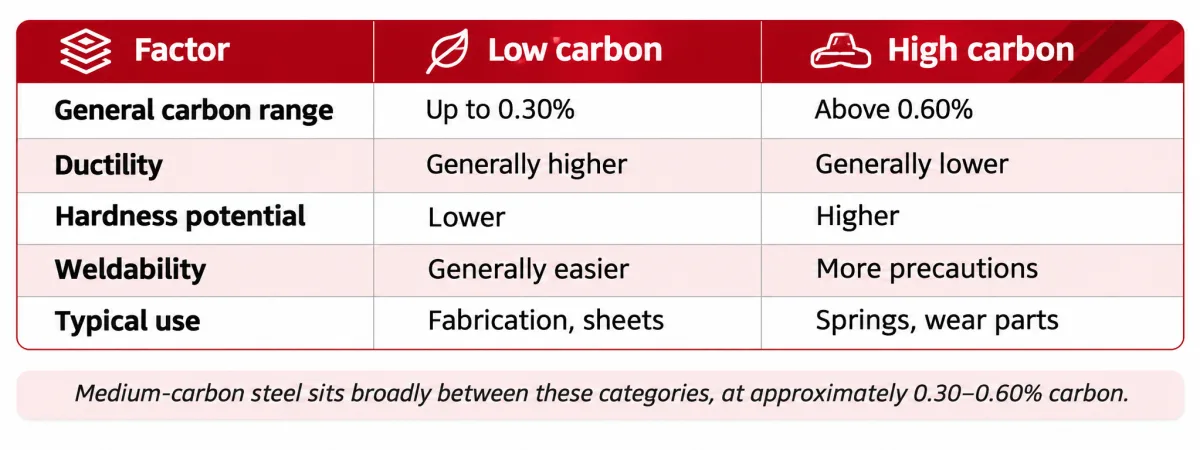
The key difference is carbon content and its influence on material behaviour. Lower-carbon grades generally suit forming and fabrication. Higher-carbon grades can achieve greater hardness and wear resistance after suitable processing. The best choice depends on the intended service conditions rather than carbon percentage alone.
8. Why does carbon equivalent matter for TMT bars?
Carbon equivalent, or CE, combines the effect of carbon and selected alloying elements into a calculated value. It helps assess welding behaviour. A favourable carbon percentage does not automatically mean that a reinforcing bar can be welded without precautions. Review the grade and approved welding procedure.
IS 1786 defines chemistry and carbon-equivalent requirements for reinforcement. The applicable calculation and limits depend on the alloying condition. Site welding should only proceed with the structural engineer’s approval and an appropriate welding procedure.
Reference: BIS: IS 1786 specification preview
9. How can buyers identify and verify steel quality?
The reliable way to identify carbon content is to review chemical test results and the Mill Test Certificate (MTC). Appearance alone cannot confirm composition or grade. Reinforcement buyers should compare the declared grade, traceability and tested mechanical properties with the applicable standard and structural drawings.
- Confirm the manufacturer, grade, diameter and applicable BIS marking.
- Match the heat, cast or lot identification to the test certificate.
- Check carbon, sulphur, phosphorus and carbon equivalent.
- Review yield strength, tensile strength and elongation.
- Confirm bend and rebend test results where required.
Our practical recommendation is to treat carbon percentage as one quality checkpoint, not a complete quality verdict. A certificate linked to the supplied batch offers more useful evidence than a generic product description.
Reference: BIS: reinforcement product certification manual
Frequently asked questions
What is low carbon steel?
It is steel with a relatively small carbon content, generally up to 0.30% in Indian industry terminology.
What is the carbon percentage in low carbon steel?
Generally up to 0.30% by mass. Specific product grades may require lower limits.
How much carbon does steel contain?
There is no single value. Plain steels are broadly grouped into low, medium and high-carbon categories based on their composition.
How to identify low carbon steel?
Check the material specification and chemical analysis. For reinforcement, match the Mill Test Certificate to the supplied batch.
What are the characteristics of low carbon steel?
It generally offers good formability, ductility and welding characteristics. Exact mechanical properties depend on grade and processing.
What is the difference between low carbon steel and high carbon steel?
Lower-carbon grades generally favour forming and fabrication. Higher-carbon grades can achieve greater hardness and wear resistance.
Conclusion
Low-carbon grades offer useful properties for construction, manufacturing and fabrication. Carbon content influences performance, but processing and grade requirements are equally important. For reinforcement, verify the chemical and mechanical results against the specified standard. Informed material selection supports reliable construction.
Looking to understand how steel resists corrosion? Read our detailed guide on Corrosion Resistant Steel (CRS) to explore its properties, benefits, and applications.
About the author
INDUS TMT INDUSTRIES LIMITED has nearly three decades of experience in steel manufacturing. Our industry knowledge covers steel composition, material properties and their role in modern construction. We aim to help engineers, contractors, dealers and homeowners make informed purchasing decisions.
Website: www.industmt.com