Introduction
Most buyers compare TMT bars by price per ton. Few compare the numbers that decide whether a bar protects the building. The Fe 550D steel specification lists those numbers.
You are buying steel for a home or a project. Dealers quote different brands, and every bar carries similar markings. Without test data, you cannot tell a strong bar from an average one. A wrong choice stays hidden inside concrete for decades.
In this guide, you will discover what Fe 550D and “D” mean, five checks that matter, and how INDUS 555-D TMT exceeds ISI Fe 550D minimums. You won’t need a lab background.
Lokesh is a B.E. Civil / M.Tech Structural Engineering graduate who specified, supervised and quality-checked Fe 550D TMT bars on 50+ residential and commercial projects across Karnataka.
Quick Comparison: ISI Fe 550D vs INDUS Fe 550D

What Is the Fe 550D Steel Specification, and What Does “D” Mean?
“Fe” marks reinforcement steel. The number 550 is the minimum yield strength in N/mm². The Bureau of Indian Standards says the letter D marks the same strength with higher minimum elongation. Source: IS 1786:2008, Bureau of Indian Standards, 2008.
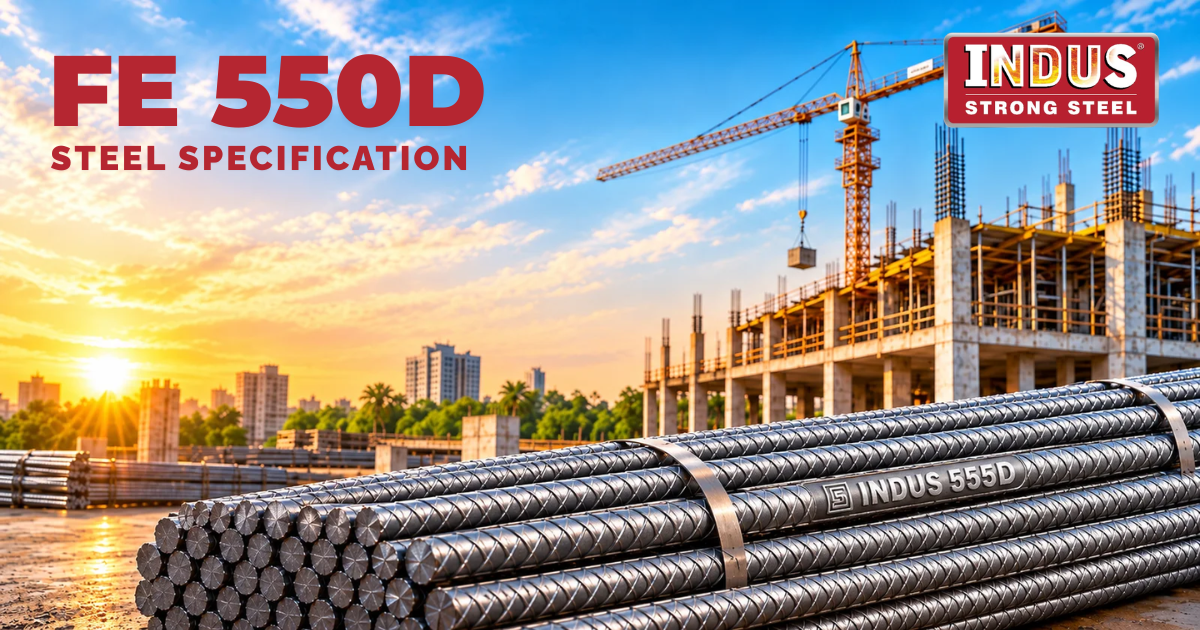
Fe 550D is a TMT bar grade with 550 N/mm² minimum yield strength. The letter D marks enhanced ductility. It works by pairing high strength with controlled elongation and low impurities. Builders use it for beams, columns, slabs and foundations in homes and commercial buildings.
Strength alone is not enough. Concrete is brittle, so the steel inside must stretch and bend before it breaks. That gives occupants a warning.
Why do low carbon, phosphorus and sulphur matter?
Low carbon, phosphorus and sulphur keep a TMT bar ductile and weldable. Excess carbon cuts ductility and weldability. Excess phosphorus and sulphur make steel brittle. A brittle bar can crack during bending, welding or an earthquake, giving no warning. INDUS Fe 550D keeps carbon at 0.22% and phosphorus and sulphur at 0.040% each.
What happens to your home if they run high?
- High carbon: High carbon equivalent bars can crack on bending and weld brittle.
Source: IS 1786 chemistry notes, InfraLens.
- High phosphorus: Phosphorus raises tensile strength but lowers ductility.
Source: Aggarwal, CSIR-NML, 2013.
- High sulphur: It is an unwanted impurity that adds brittleness.
- In a house: weak stirrups, cracked welded joints and sudden failure under overload.
INDUS also holds manganese at 0.62% minimum for flexibility with strength. Before you buy, check the five values below. Then confirm the chemistry on the test report.
1. What Yield Strength Should Fe 550D TMT Steel Have?
Yield strength tells you how much load a bar carries before it deforms permanently. TMT bars show no sharp yield point, so IS 1786 uses 0.2% proof stress.
Yield strength is the stress at which a TMT bar begins to deform permanently. Labs measure it as 0.2% proof stress in a tensile test. ISI Fe 550D requires 550 N/mm² minimum. INDUS Fe 550D delivers 560 N/mm² minimum, giving extra strength for beams, columns and slabs.
INDUS Fe 550D sits 10 N/mm² above the ISI floor.
2. How Much Tensile Strength Does a Fe 550D TMT Bar Need?
Tensile strength is the peak load a bar survives before it breaks. A higher value gives more reserve in overloaded or poorly cast members.
Tensile strength is the maximum stress a steel bar withstands before it breaks. A tensile test records it. ISI Fe 550D requires 600 N/mm² minimum. INDUS Fe 550D specifies 650 N/mm² minimum. That reserve gives buildings an extra safety margin under heavy loads.
That is 50 N/mm² above the ISI minimum, about 8% more.
3. Why Does Elongation Matter in the Fe 550D Steel Specification?
Elongation shows how far a bar stretches before it snaps. A ductile bar gives visible warning before failure.
Elongation is the percentage a bar stretches before it fractures. It measures ductility. ISI Fe 550D requires 14.5% minimum. INDUS Fe 550D specifies 17%. Higher ductility lets bars bend and warn before failing under overload, which suits all construction types.
Real-life example: Surveys after the 2001 Bhuj earthquake listed poor detailing and workmanship among the causes of framed-building collapses. Steel grade was not blamed. But the event shows why a frame needs ductility built in. Source: Lessons from the 2001 Gujarat Earthquake, WCEE.
4. How Do Bend and Rebend Tests Prove Steel Bar Quality?
Site crews bend steel bars into stirrups, hooks and cranks every day. A bar that cracks while bending is useless and dangerous.
The bend test folds a bar 180 degrees around a mandrel. The rebend test bends it again after ageing. Neither may show cracks. INDUS Fe 550D passes tighter mandrels, 3D/4D for bend and 5D/6D for rebend, against 4D/5D and 6D/7D for ISI Fe 550D.
Real-life example: Ground-floor columns that failed in the 2001 Bhuj earthquake had widely spaced ties and 90-degree hooks. Ductile detailing uses 135-degree hooks instead. Forming them needs a bar that bends sharply without cracking. Source: Non-ductile frames, GEM Taxonomy.
5. Why Is a High UTS/YS Ratio Important in TMT Bars?
This ratio shows how much strength a bar keeps after it yields. Engineers watch it closely in seismic design.
The UTS/YS ratio compares a bar’s tensile strength with its yield strength. A higher ratio means more reserve strength after yielding. ISI Fe 550D requires 1.08. INDUS Fe 550D specifies 1.16. Engineers value it because it gives better earthquake resistance in seismic design.
A ratio of 1.16 means the bar can carry 16% more load after it begins to yield.
Expert View and On-Site Insight
“enhanced specified minimum percentage elongation” — Bureau of Indian Standards, IS 1786:2008, 2008
Original insight: “On Karnataka sites, I have seen bars bought as Fe 550D arrive without any test report. A chemical and mechanical report per lot settles the question before bending starts.”
INDUS 555-D TMT supplies chemical and mechanical test reports, so you can verify every value above.
Conclusion
The Fe 550D steel specification comes down to five checks: yield strength, tensile strength, elongation, bend and rebend, and UTS/YS ratio. Low carbon, phosphorus and Sulphur protect those numbers. INDUS 555-D TMT meets each check above the ISI minimums, backed by test reports.
Frequently Asked Questions
Fe 550D steel means ?
Fe 550D is a TMT steel bar grade. “Fe” means iron, “550” means a minimum yield strength of 550 N/mm², and “D” means ductile, so the bar can stretch more before it breaks.
What is the difference between Fe 550 and Fe 550D?
Fe 550 and Fe 550D have the same minimum yield strength (550 N/mm²). The difference is ductility: Fe 550D needs at least 14.5% elongation, while Fe 550 needs only 10%. This makes Fe 550D better at bending and stretching before it breaks.
Which Fe grade steel is best?
Fe 550D is one of the best grades for house construction because it is strong (550 N/mm² minimum yield) and ductile (14.5% minimum elongation).
INDUS also produces Fe 550D, which exceeds the ISI minimum requirements, with 560 N/mm² yield strength, 650 N/mm² tensile strength and 17% elongation. See INDUS TMT steel products.
How can I verify Fe 550D quality before buying?
Ask for chemical and mechanical test reports. Check yield, tensile, elongation, bend, rebend and UTS/YS values against the specification.