
Executive Engineering Takeaways
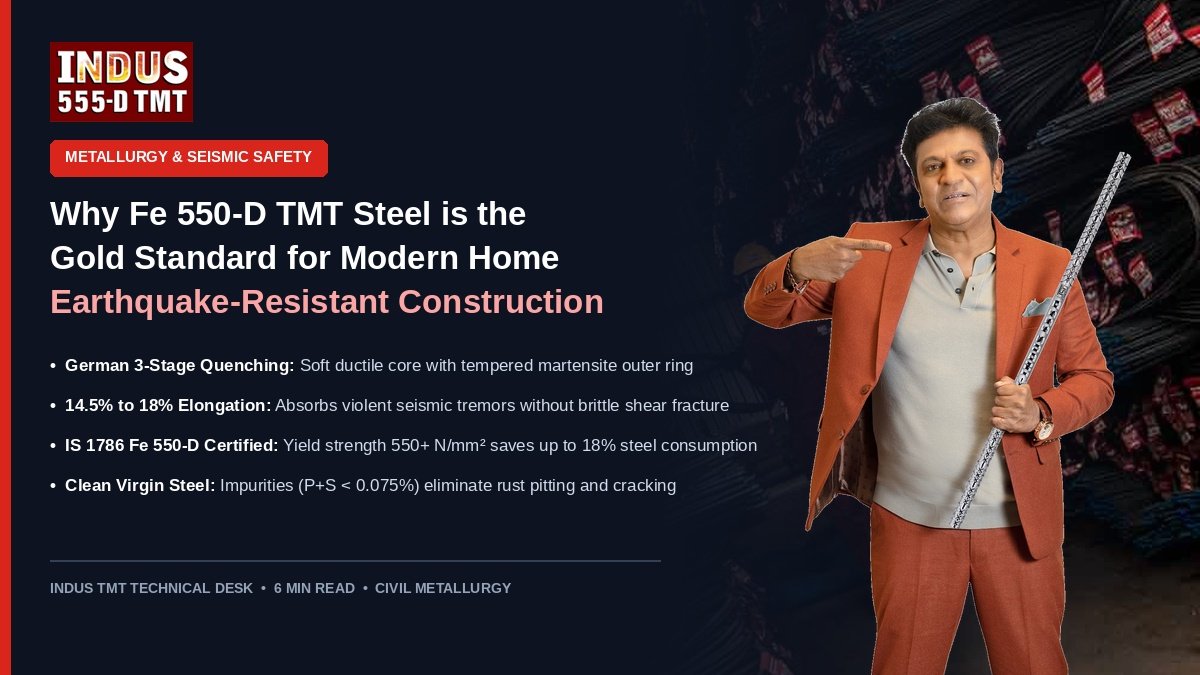
- High Uniform Ductility: Fe 550-D grade guarantees 14.5% to 18% minimum uniform elongation, safely absorbing dynamic seismic shockwaves without catastrophic brittle snapping.
- 18% Steel Consumption Savings: With a certified yield strength of 550+ N/mm², structural engineers can reduce overall rebar weight in RCC columns, beams, and footings.
- German 3-Stage Quenching: Automated in-line thermo-mechanical treatment creates a hard, corrosion-resistant tempered martensite crust surrounding an ultra-ductile ferrite-pearlite core.
- Virgin Primary Billet Steel: Induction melted from pure iron ore with combined Phosphorus and Sulphur restricted below 0.075%, preventing localized stress cracking.
Across South India—including rapidly urbanizing metropolitan corridors like Bengaluru, Chennai, Coimbatore, and Mysuru—structural engineers and civil architects are unanimously moving away from conventional Fe 415 and standard Fe 500 rebars. In their place, Fe 550-D high-ductility TMT steel has emerged as the definitive benchmark for multi-story residential framing, commercial complexes, and independent luxury villas.
1. The Critical Difference: What Does the "D" in Fe 550-D Signify?
In the Bureau of Indian Standards classification (BIS IS:1786), "Fe" denotes iron, "550" represents the minimum yield strength of 550 N/mm² (MPa), and the letter "D" stands for "Ductility".
While standard Fe 550 rebars offer high strength, they often carry lower elongation values (around 8% to 10%), rendering them vulnerable to brittle fracture under sudden cyclical loading. By contrast, Indus 555-D (Fe 550-D) guarantees a minimum elongation of 14.5% (often reaching 18%), paired with a minimum tensile-to-yield strength ratio (UTS/YS) of at least 1.10 to 1.15.
This critical ratio ensures that during an earthquake or severe storm loading, the building's structural frame bends elastically and absorbs seismic energy rather than collapsing abruptly without warning.
2. German Tricore Technology: The Anatomy of a High-Performance Rebar
The superior mechanical properties of Indus 555-D are produced through proprietary automated 3-stage quenching technology at our integrated rolling mills in Hosur:
- Stage 1 - Intense Rapid Quenching: The red-hot steel bar leaving the finishing stand at over 950°C passes through high-pressure computerized water nozzles. The outer surface is instantaneously cooled, converting into a tough, wear-resistant, and corrosion-defying tempered martensite shell.
- Stage 2 - Thermal Equalization: As the bar exits the water chamber, intense residual heat from the still-hot core radiates outwards, self-tempering the outer martensitic layer into a ductile, stress-free casing.
- Stage 3 - Atmospheric Cooling: On the automated cooling bed, the core transforms slowly into a fine-grained ferrite-pearlite microstructure, providing maximum flexibility and high elongation capacity.
Seismic Zoning Fact
Under the updated National Building Code (NBC 2016) and IS 13920:2016 (Ductile Design and Detailing of Reinforced Concrete Structures), only high-ductility rebars carrying the 'D' designation are recommended for Zone III, IV, and V seismic construction.
3. Structural Cost Economics: Saving Up to 18% Steel
Upgrading from legacy Fe 415 or standard Fe 500 to Indus 555-D Fe 550-D delivers direct cost savings on your total project budget:
| Steel Grade | Min. Yield Strength (N/mm²) | Min. Elongation (%) | Relative Consumption | Seismic Performance |
|---|---|---|---|---|
| Fe 415 | 415 | 14.5% | Baseline (100%) | Low Yield Capacity |
| Fe 500 | 500 | 12.0% | ~88% (-12%) | Moderate Ductility |
| Indus 555-D (Fe 550-D) | 550+ | 14.5% - 18.0% | ~82% (-18%) | Exceptional (Gold Standard) |
Because higher yield capacity allows structural consultants to design slimmer column cross-sections and optimize rebar spacing, a typical 3-story residential project requiring 10 tons of Fe 415 can achieve the exact same or superior safety margin with just 8.2 to 8.5 tons of Indus 555-D steel.
4. Advanced CNC X-Ribs for Concrete Anchoring
Strength in a rebar is only as effective as its bond with the surrounding concrete matrix. Indus 555-D features precision CNC-machined transversal and longitudinal X-rib patterns. The deep rib height and optimal rib pitch create 300% greater contact surface area, preventing rebar slippage under extreme bending moments and seismic tremors.
Conclusion & Recommendation
Building your home is a generational investment meant to stand for over a century. By insisting on certified Indus 555-D Fe 550-D TMT rebars sourced directly from our Hosur integrated plant, you secure uncompromising seismic safety, superior rust resistance, and optimized structural costs.

Civil Engineers Discussion & Inquiries (3)
Very thorough comparison. We switched to Indus Fe-550D for our G+4 residential project in Whitefield, and the test report confirmed 16.5% elongation and zero cracks on 180-degree bend.
Does Indus supply custom cut-and-bend lengths directly from the Hosur mill to minimize site scrap?
Leave an Engineering Comment or Inquiry